
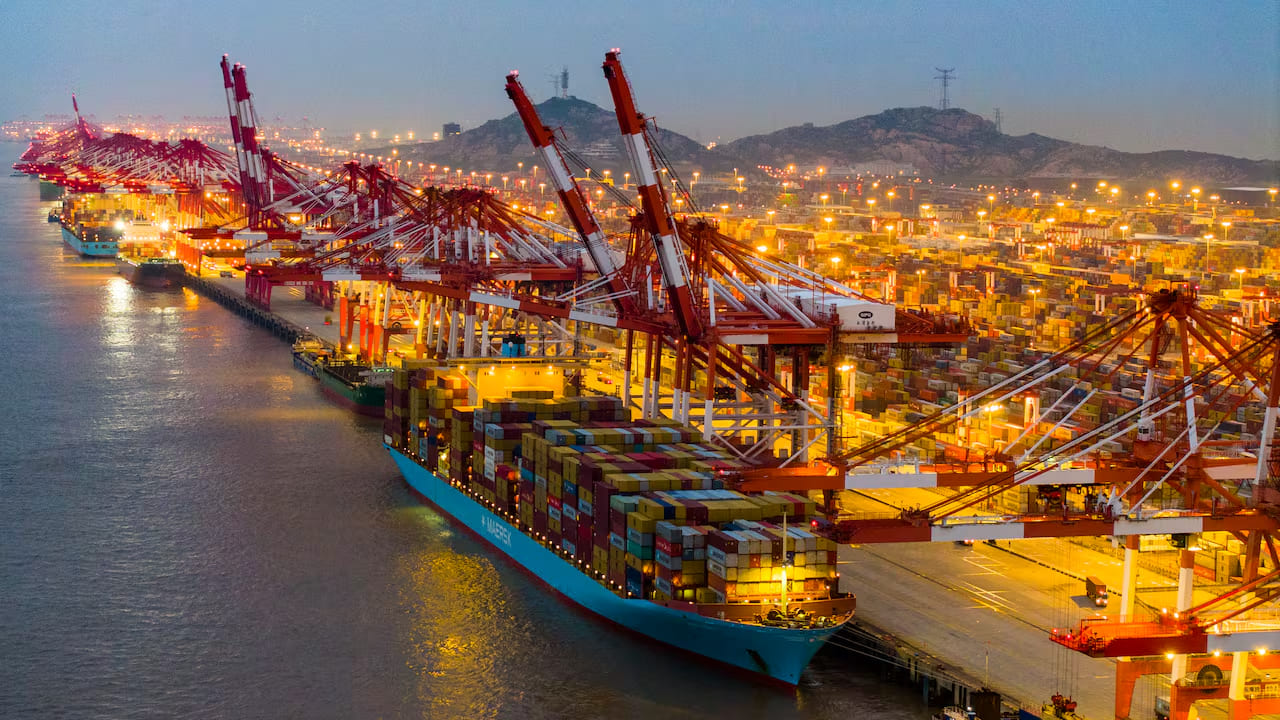
Port congestion in Shanghai and Ningbo-Zhoushan has once again raised concerns for international trade. Operational closures caused by typhoons in August exacerbated an already complex situation, with delays at terminals, a backlog of waiting vessels, and strain on maritime services.
Shanghai and Ningbo-Zhoushan are two of Asia’s main port hubs. When their operations are affected, the impact quickly spills over into international routes: schedules change, available space is reduced, connections are rescheduled, and the risk of losing reserved space on ships increases.
In this scenario, for South American importers and exporters, the main problem is not only the delay at the point of origin, but also the loss of predictability. A container may not be loaded onto the scheduled vessel, its connection may change, its estimated arrival date may be modified, or it may incur additional costs for storage, rescheduling, and operational adjustments.
What this means for operations with South America
Routes between Asia and South America are especially sensitive to these types of disruptions. Congestion in Chinese ports can affect shipments destined for Chile, Argentina, and other markets in the region, both in terms of space availability and the stability of itineraries.
Therefore, in congested environments, it’s not enough to simply look at the estimated departure date. It’s necessary to review actual space availability, port alternatives, possible port omissions, connections, transit times, and delivery windows at the destination.
Advance planning becomes key. Booking further in advance, validating documentation, coordinating with suppliers, and keeping shipment information up-to-date allows you to reduce the impact of delays and make decisions before the problem reaches its destination.
Why choose Interandes Shipping?
In an increasingly volatile maritime market, having a specialized freight forwarder makes a real difference. Interandes Shipping S.A., a business unit of Grupo All In, supports its clients with continuous monitoring of the international market, route analysis, and operational coordination for imports and exports.
Our work goes beyond simply securing space on a vessel. We analyze the context, anticipate potential changes, review alternatives, and maintain constant communication so that each client can make decisions based on real-time, up-to-date information.
In operations between Asia, Chile, and Argentina, this ability to read and respond is fundamental. When a route becomes strained, the value lies in having a team that can assess scenarios, propose solutions, and sustain operations with greater predictability.
The congestion in Shanghai isn’t just port news. It’s a signal for the entire logistics chain: in international trade, anticipating problems always costs less than reacting too late.